Art and Culture
Roma è un museo a cielo aperto. Dal nostro Hotel potrai esplorare facilmente le principali meraviglie artistiche: San Pietro, Musei Vaticani, Cappella Sistina, Castel Sant’Angelo, Piazza Navona, Trevi, Piazza di Spagna, Colosseo.
St. Peter's Basilica
St. Peter's Basilica in the Vatican is the Catholic basilica of the Vatican City, the symbol of the Vatican State, crowned by the monumental St. Peter's Square. It is the largest of the four papal basilicas in Rome, often described as the largest church in the world and the center of Catholicism, hosting the main manifestations of Catholic worship.
Among the main artists and architects who worked on its construction over the years we find Bramante, Raphael, Michelangelo, Maderno, Bernini, Borromini and many others.
Vatican Museums and Sistine Chapel
The Vatican Museums are located within the Vatican City State and are one of the largest art collections in the world, displaying the enormous collection of artworks amassed by the Popes over the centuries. The Sistine Chapel and the papal apartments, frescoed by Michelangelo and Raphael, are among the works that museum visitors can admire on their tour.
The Sistine Chapel is one of the most famous cultural and artistic treasures of the Vatican City, part of the Vatican Museums. It was built between 1475 and 1481, during the reign of Pope Sixtus IV della Rovere, from whom it takes its name. The Sistine Chapel, in addition to housing great masterpieces by Michelangelo, Botticelli, Ghirlandaio, and others, is one of the three Papal Chapels in the Vatican Apostolic Palace and is known throughout the world both for being the site of the conclave and other official papal ceremonies, and for being decorated with one of the most famous and celebrated works of art in Western art: Michelangelo Buonarroti's frescoes, which cover the vault and the back wall of the Last Judgement above the altar.
Castel Sant'Angelo
Castel Sant'Angelo, also known as Hadrian's Mausoleum, is located on the right bank of the Tiber across from the Sant'Angelo Bridge, a short distance from the Vatican, in the Borgo district. It is connected to the Vatican City via the fortified "passetto" corridor. The castle underwent radical modifications several times during the Middle Ages and the Renaissance.
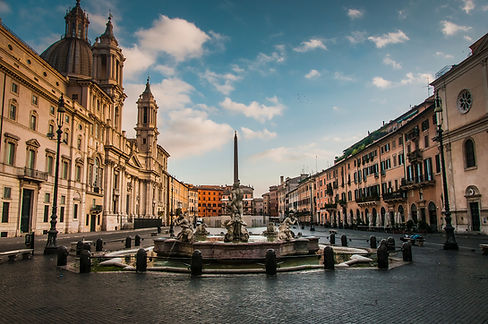
Piazza Navona
Piazza Navona is one of Rome's most famous squares, built by the Pamphili family. Its shape is that of an ancient stadium: it was built in monumental style at the behest of Pope Innocent X. It is undoubtedly one of the most elegant and joyful Roman squares, having risen on the ashes of the Stadium of Domitian. Today, the square is a gathering place for locals and tourists, who linger in the many outdoor cafés surrounding it. Used in ancient times for athletic contests and competitions of various kinds, today the square hosts daily street artists, painters, and portraitists who, in just a few minutes, manage to capture the most characteristic features of the model. At the center of the square are Bernini's magnificent Fountain of the Four Rivers and Borromini's church of Sant'Agnese in Agone.
Fontana di Trevi
The Trevi Fountain is the largest and one of the most famous fountains in Rome. It is, in fact, considered one of the most famous fountains in the world. The Trevi Fountain appears to us as a marvel, a jewel of water and stone. Its presence, in fact, can be felt even as you wander through the nearby alleys: it is the water that, with a loud and growing roar, suddenly explodes into the square, where it presents itself in a breathtaking spectacle.
Piazza di Spagna and the Spanish Steps
Piazza di Spagna, with the Spanish Steps, is one of Rome's most famous squares. It takes its name from the Palazzo di Spagna, home to the Spanish Embassy to the Holy See. At the center of the square is the famous Barcaccia Fountain, dating back to the early Baroque period and sculpted by Bernini. Its monumental 135-step staircase was built to connect the Bourbon Spanish Embassy to the church of Trinità dei Monti.
Colosseum and Roman Forum
The Colosseum, originally known as the Flavian Amphitheater, is the largest amphitheater in the world, located in the center of Rome. With an estimated capacity of 50,000 to 75,000 spectators, it is the most important Roman amphitheater and the most impressive surviving monument of ancient Rome. It is known throughout the world as a symbol of Rome and one of the symbols of Italy.